

Posts Categories
Latest Posts
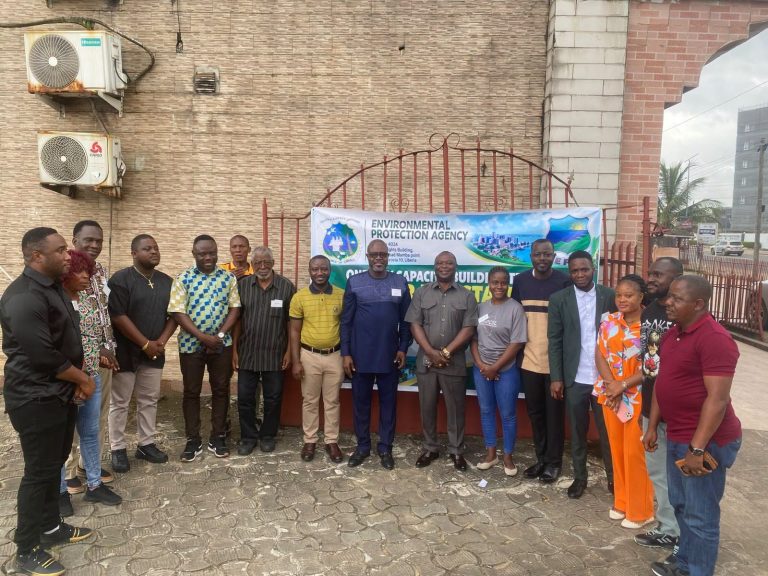
Monrovia, Liberia — September 25, 2026_The Environmental Protection Agency (EPA) has conducted a one-day capacity-building training for staff of its Department of Projects (DPM), with emphasis on strengthening project management, coordination, accountability, and results-based delivery.
The training, held at the Corina Hotel in Monrovia on Friday, September 25, 2026, brought together EPA staff to enhance their capacity to develop, manage, and implement projects that respond to Liberia’s environmental priorities and compete effectively for funding from development partners and climate finance institutions.
Speaking on behalf of the EPA Executive Director, Dr. Emmanuel Urey Yarkpawolo, who is currently in the United States attending the 81st Session of the United Nations General Assembly, Deputy Executive Director for Administration, Hon. Anthony S. Kollie, said the training comes at a critical time for Liberia as the country faces growing environmental and climate-related challenges.
He identified climate change, coastal erosion, deforestation, waste management, pollution, and rapid urbanization as some of the major challenges requiring stronger institutional responses.
Hon. Kollie said the training is intended to help the EPA develop “winnable” projects that are well-conceived, evidence-based, technically sound, aligned with national priorities, and competitive within the increasingly demanding global funding environment.
He emphasized integrity, sound financial management, and results and accountability as three key principles that should guide the work of the Project Development and Management Department.
“Every dollar that comes into an EPA project is public money, whether from government, development partners, or climate funds,” Hon. Kollie said, stressing the need for strict financial controls, accurate reporting, proper documentation, and responsible management of project resources.
He also challenged staff to ensure that EPA projects go beyond the disbursement of funds and produce measurable benefits for communities and the country.
According to him, projects should contribute to concrete improvements in areas including coastal resilience, forest protection, waste management, pollution control, environmental governance, and climate adaptation and mitigation.
The Deputy Executive Director further stressed the importance of designing projects that are people-centered, with women, youth, and vulnerable groups actively involved in planning, implementation, and monitoring.
He said community participation is essential to ensuring ownership, sustainability, and meaningful impact from EPA interventions.
Hon. Kollie also called for stronger consideration of cross-cutting issues, including climate risk and resilience, gender equality, social inclusion, transparency, communication, independent project monitoring, and partnerships with government institutions, local authorities, civil society, the private sector, and international organizations.
He noted that environmental protection is a shared responsibility and that the EPA cannot achieve its mandate alone.
The training also provided an opportunity to recognize newly assigned staff within the Project Development and Management Department. Hon. Kollie encouraged the new staff to bring fresh energy, professionalism, discipline, and commitment to their responsibilities while urging experienced employees to share their knowledge and institutional experience.
“This workshop is not just a training event; it is a commitment,” Hon. Kollie said. “A commitment that as the Project Development and Management team, we will raise our standards, compete effectively for resources, implement with discipline, and account honestly for our results.”
He encouraged participants to actively engage throughout the training, ask questions, challenge assumptions, and share lessons from both successful and unsuccessful experiences.
The one-day training, held under the theme “Strengthening Project Management, Coordination and Results-Based Delivery,” focused on the project cycle, including project identification, design, appraisal, implementation, monitoring, evaluation, and closure.