
Posts Categories
Latest Posts
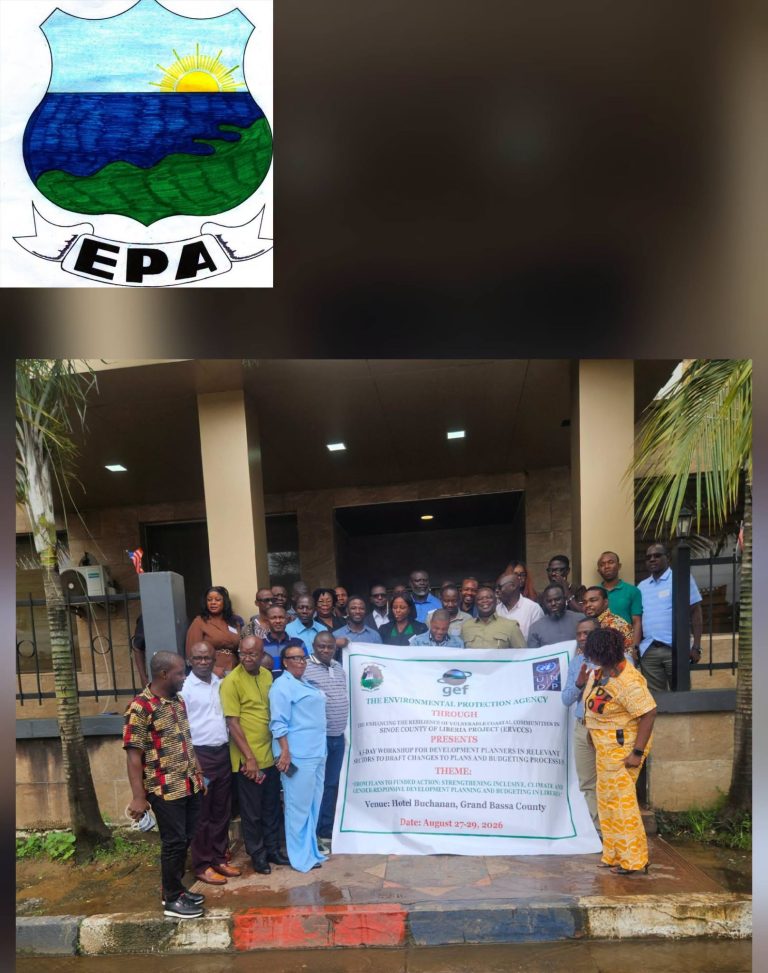
Buchanan, Grand Bassa County, August 27, 2026 — The Environmental Protection Agency (EPA) of Liberia through the Enhancing the Resilience of Vulnerable Coastal Communities in Sinoe County of Liberia (ERVCCS) Project, with support from the Global Environment Facility (GEF) and the United Nations Development Programme (UNDP), has begun a three-day workshop aimed at strengthening climate-responsive development planning and budgeting, with a focus on ensuring that climate resilience is better integrated into Liberia’s development priorities and investments.
The workshop, which runs from August 27–29, 2026, at Hotel Buchanan in Grand Bassa County, is being held under the theme: “From Plans to Funded Action: Strengthening Inclusive, Climate and Gender-Responsive Development Planning and Budgeting in Liberia.”
The workshop brings together development planners and technical officers from key government ministries, agencies, county and municipal authorities, and development partners to examine how climate change considerations can be integrated into existing development planning and budgeting processes.
Speaking at the opening ceremony, Deputy Executive Director for Administration of the EPA, Hon. Anthony S. Kollie, said climate change is no longer an abstract concept for Liberia but a daily reality, particularly for communities along the country’s coastline.
Representing the EPA Executive Director and Management, Hon. Kollie said coastal communities are increasingly experiencing coastal erosion, rising sea levels, recurrent flooding, saltwater intrusion, and unpredictable weather patterns.
He noted that these impacts are undermining livelihoods, damaging public infrastructure, degrading natural resources, and threatening the social and economic stability of vulnerable communities.
Hon. Kollie acknowledged Liberia’s progress in incorporating climate change into national policies, strategies, and international commitments but stressed that a critical gap remains in translating those commitments into county development plans, sector strategies, annual work plans, public investment plans, and budget frameworks.
“Without closing this gap, our policies will not deliver the resilience our people urgently need,” Hon. Kollie said.
He explained that the EPA, through the ERVCCS Project, is working to strengthen the capacity of planning and budgeting institutions to integrate climate change adaptation, Integrated Coastal Zone Management (ICZM), and sea and river defence risk management into development processes across Liberia’s nine coastal counties.
According to Hon. Kollie, the workshop is intended to produce concrete changes to existing planning and budgeting systems, ensuring that development plans, annual work plans, and budgets adequately reflect climate risks and support climate-smart investments.
He emphasized that the process is not about creating parallel systems, but strengthening existing government planning and budgeting mechanisms.
Hon. Kollie encouraged participants to actively engage in the discussions, share their experiences and challenges, and work collectively to develop practical recommendations that can be implemented following the workshop.
Providing the background and rationale for the workshop, J. Komoty Gee Zean, Administration and Finance Officer and Acting Project Manager of the ERVCCS Project, said climate change continues to pose significant threats to Liberia’s coastal communities.
He said counties such as Sinoe are increasingly experiencing coastal erosion, sea-level rise, flooding, saltwater intrusion, and changing weather patterns, affecting communities, livelihoods, infrastructure, and natural resources.
Zean noted that while Liberia has made considerable progress in incorporating climate change into national policies and development strategies, those commitments are yet to be fully reflected in county development plans, sector plans, annual work plans, public investment plans, and budget frameworks.
He explained that the ERVCCS Project is supporting government institutions to address this gap by strengthening their capacity to integrate climate change adaptation measures, Integrated Coastal Zone Management principles, and Sea and River Defense Investment Management Plan interventions into development planning and budgeting.
He said the initiative seeks to promote climate-resilient investments and strengthen the resilience of vulnerable coastal communities across Liberia.
Welcoming participants to Grand Bassa County, Moses G. Henry, Grand Bassa County Development Officer, expressed appreciation to the EPA and its partners for choosing Buchanan as the venue for the important national engagement.
Henry extended a warm welcome to participants from government ministries, agencies, counties, and partner institutions, noting that Grand Bassa was pleased to host the gathering.
He said the county was particularly pleased to provide a hospitable environment for participants and expressed hope that their presence would contribute to meaningful discussions and outcomes from the workshop.
“We are very happy to welcome all of you to Grand Bassa County. We are pleased to have you here and hope you will feel at home during your stay with us,” Henry said in his welcoming remarks.
He further thanked the organizers and participants for making the trip to Buchanan and encouraged them to take advantage of the opportunity to engage in the discussions.
The workshop brings together approximately 50 development planners and technical officers from relevant government institutions and development partners.
Participating institutions include the Environmental Protection Agency, Ministry of Finance and Development Planning, Ministry of Agriculture, Ministry of Mines and Energy, Ministry of Commerce and Industry, Ministry of Public Works, National Fisheries and Aquaculture Authority, National Disaster Management Agency, Ministry of Local Government, National Climate Change Secretariat, county-level planning authorities, and development partners.
Participants will review existing planning and budgeting processes, identify gaps and entry points for mainstreaming climate resilience, and develop proposed changes that can be incorporated into existing government systems.
The workshop methodology includes technical presentations, sector-based group discussions, practical exercises, plenary presentations, peer review, and the development of an action plan.
The three-day engagement is expected to produce a review of existing planning and budgeting processes, identify opportunities for integrating climate resilience, and develop draft proposals for changes to relevant planning and budgeting procedures.
Participants are also expected to develop practical recommendations and an action plan outlining institutional responsibilities, timelines, priority actions, and resources required to implement the proposed changes.
Ultimately, the EPA expects the workshop to contribute to more climate-responsive annual work plans and budgets, stronger coordination among government institutions, and improved alignment between development priorities, budgetary allocations, and climate risks.