
Monrovia, Liberia – August 6, 2026 – The Environmental Protection Agency (EPA) of Liberia on Wednesday, August 5, 2026, welcomed a delegation from the Embassy of the United States of America for high-level discussions focused on environmental governance, mining regulation, marine ecosystem protection, concession monitoring, and opportunities to strengthen bilateral cooperation on environmental management.
The U.S. delegation, led by Tiffany Miller, Senior Political Officer, and accompanied by Thomas Quaye, Political/Human Rights Assistant, visited the EPA Headquarters in Monrovia to gain a better understanding of the Agency’s statutory mandate and ongoing efforts to address Liberia’s growing environmental challenges.
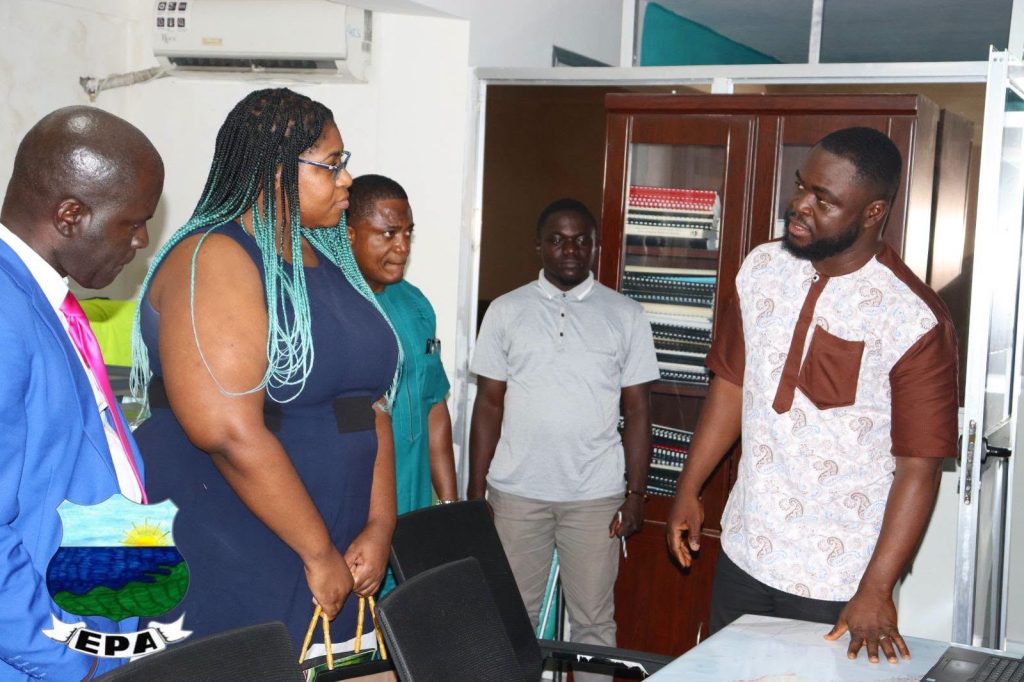
Welcoming the delegation at the EPA`s headquarters, EPA Executive Director Dr. Emmanuel K. Urey Yarkpawolo outlined the Agency’s legal mandate, emphasizing its responsibility to regulate, coordinate and monitor activities affecting Liberia’s environment while promoting sustainable development and responsible investment.
A significant portion of the discussions centered on the Inter-Agency Mining Taskforce recently established by President Joseph Nyuma Boakai, Sr. The U.S. delegation sought to understand the circumstances that led to the creation of the taskforce and its role in addressing environmental violations within Liberia’s mining sector.
Dr. Yarkpawolo explained that the EPA is a key member of the taskforce, which was constituted following the Agency’s nationwide environmental compliance monitoring exercise conducted in May this year. According to him, the assessment uncovered alarming levels of environmental degradation, including widespread land destruction, pollution of rivers and streams, and the loss of forest cover in several mining communities across the country.
“The findings of the nationwide assessment coupled with the Ministry of Mines and Energy assessment that uncovered wide spread environmental and mining laws violations demonstrated the need for stronger inter-agency coordination to address environmental crimes and illegal mining activities,” Dr. Yarkpawolo told the delegation.
He disclosed that the taskforce has already held several planning meetings and is expected to begin intensive capacity-building activities, including a training session scheduled for Friday, August 7, 2026. The training will familiarize members with the EPA’s environmental regulatory framework, including the Environmental Protection and Management Law, Environmental and Social Impact Assessment (ESIA) requirements, environmental policies, approved guidelines, and regulations governing natural resource management.
Dr. Yarkpawolo stressed that the operations of the taskforce must be guided by sound environmental principles to ensure that Liberia’s natural resources are utilized responsibly while supporting sustainable economic growth.
The meeting also explored the implementation and monitoring of concession agreements signed between the Government of Liberia and concession companies operating in the country.
Responding to questions from the U.S. delegation, Dr. Yarkpawolo explained that oversight of concession agreements is shared among relevant government ministries and agencies in accordance with their statutory mandates.
He noted that the EPA’s primary responsibility is to ensure that concessionaires comply with the Environmental Protection and Management Law, particularly environmental permitting requirements and the Environmental and Social Impact Assessment (ESIA) process before project implementation.
He further explained that when communities raise legitimate concerns regarding corporate social obligations, the EPA works with relevant stakeholders and may withhold environmental authorization until such issues are adequately addressed.
“Our responsibility is to enforce environmental laws while ensuring that Liberia maintains a responsible and investor-friendly environment,” he said.
The discussion also touched on the recent arrest of several foreign nationals, including Chinese citizens, during the EPA’s nationwide environmental compliance operation.
Dr. Yarkpawolo informed the delegation that those arrested were engaged in activities that caused significant environmental damage and were operating without the required environmental permits issued by the EPA.
He said the Liberia National Police carried out the arrests upon the EPA’s request, noting that the Agency continues to collaborate closely with the police in enforcing Liberia’s environmental laws due to limited enforcement personnel.
According to him, companies whose operations have been suspended are required to restore degraded sites and carry out environmental remediation before they can be considered for reopening.
While acknowledging improved environmental compliance among many Class A and Class B mining companies, Dr. Yarkpawolo expressed concern that numerous Class C mining operators continue to pose serious threats to Liberia’s forests, rivers and surrounding communities through unsustainable mining practices.
Marine environmental protection also featured prominently during the discussions.
The U.S. delegation expressed interest in Liberia’s efforts to address illegal fishing by foreign industrial trawlers and strengthen the protection of the country’s marine ecosystem.
Dr. Yarkpawolo noted that Liberia is a signatory to the Agreement on Biodiversity Beyond National Jurisdiction (BBNJ) and several international conventions relating to ocean governance.
He explained that the EPA works in close collaboration with the National Fisheries and Aquaculture Authority (NaFAA) and the Liberia Maritime Authority by providing technical support on environmental matters affecting Liberia’s marine resources.
Recognizing the increasing threat of illegal, unreported and unregulated fishing, the EPA Executive Director appealed to the United States Government to support capacity building for Liberian professionals involved in fisheries monitoring and environmental surveillance.
He also called for assistance in strengthening the operational capacity of the Liberia Coast Guard to improve monitoring and enforcement against illegal fishing activities within Liberia’s territorial waters.
Dr. Yarkpawolo further appealed for continued U.S. support to strengthen the EPA’s logistical capacity, facilitate the establishment of specialized Environmental Courts, and deepen collaboration between the EPA of Liberia and the United States Environmental Protection Agency.
He thanked the United States Government for its previous support, particularly the donation of two Toyota Land Cruiser vehicles, which he said has significantly enhanced the work of the EPA’s Compliance and Enforcement Department during field inspections and enforcement operations.
Following the meeting, the U.S. delegation toured the EPA’s newly acquired office building, including the Geographic Information Systems (GIS) Unit and the Agency’s state-of-the-art Environmental Laboratory, where they were briefed on the technological advancements being made to strengthen environmental monitoring and scientific analysis in Liberia.
Speaking at the close of the visit, Tiffany Miller commended Dr. Yarkpawolo and the EPA for their commitment to addressing Liberia’s environmental challenges and promoting sustainable natural resource management.
She thanked the EPA for the insightful discussions and reaffirmed the United States Government’s commitment to continued collaboration with Liberia in advancing environmental protection, institutional capacity, and sustainable development initiatives.