
Posts Categories
Latest Posts
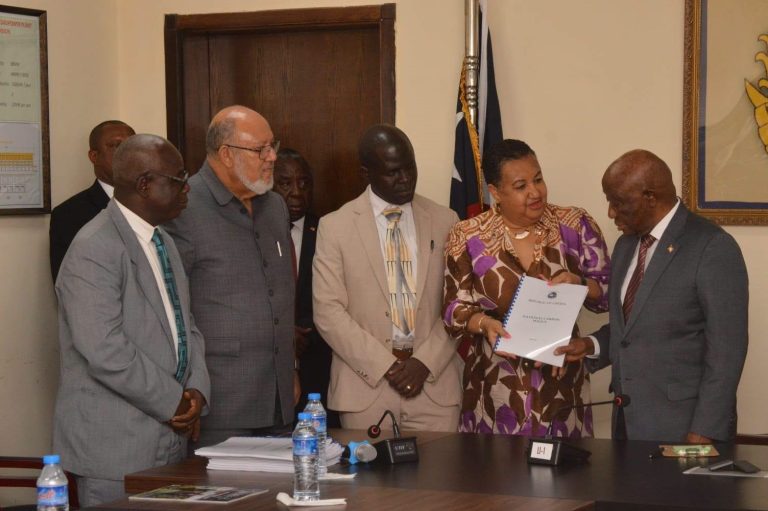
Monrovia, Liberia — September 1, 2026: Liberia has taken a significant step toward establishing a transparent and sustainable carbon market with the presentation of its consolidated and validated National Carbon Market Policy to President Joseph Nyuma Boakai, Sr., at the Executive Mansion.
The policy was presented by Madam Jeanine Cooper, Chief Executive Officer of the Carbon Markets Authority; Mr. Rudolph Merab, Managing Director of the Forestry Development Authority; and Dr. Emmanuel K. Urey Yarkpawolo, Executive Director of the Environmental Protection Agency, alongside technical representatives from the three institutions.
The National Carbon Market Policy provides a comprehensive framework for the development, regulation and trading of carbon credits in Liberia. A carbon credit represents a verified reduction or removal of one metric ton of carbon dioxide, or its equivalent, from the atmosphere. Such credits may be purchased by countries, companies and other institutions seeking to meet their climate commitments.
Liberia is strategically positioned to benefit from the expanding global carbon market. The country contains approximately 69 percent of the remaining Upper Guinean Forest ecosystem and contributes only a small share of global greenhouse gas emissions. Its forests, mangroves, wetlands and other natural ecosystems absorb and store substantial amounts of carbon while supporting livelihoods and providing food, water and medicine to communities.
The policy extends beyond forest conservation and creates opportunities for carbon projects across multiple sectors, including agriculture, renewable energy, waste management, transportation, industry, coastal and marine ecosystems, urban development and ecotourism.
Potential initiatives include reforestation and mangrove restoration, solar and hydropower development, clean cooking programs, climate-smart agriculture, recycling and composting, landfill gas capture and low-emission public transportation.
Under the policy, the Carbon Markets Authority will serve as Liberia’s principal carbon-market regulator, with exclusive authority to approve the transfer and trading of carbon credits. The Authority will collaborate with the Environmental Protection Agency, Forestry Development Authority and other relevant ministries and agencies in reviewing and regulating carbon projects.
The Forestry Development Authority will provide technical guidance on forest-carbon initiatives, while the EPA will oversee projects involving waste management, industrial emissions and designated marine and urban activities.
To strengthen transparency and accountability, the policy provides for the establishment of a National Carbon Registry under the Carbon Markets Authority. The registry will record, track and account for every authorized carbon credit through unique identification numbers. Public access to registry information, subject to legal and legitimate intellectual-property protections, will help prevent the double counting or sale of carbon credits.
The Environmental Protection Agency will lead the development and operation of Liberia’s Measurement, Reporting and Verification system. The system will measure greenhouse-gas reductions, verify project outcomes and generate reliable information for national and international climate reporting. Independent experts will also be required to verify emission reductions before carbon credits may be issued or traded.
The policy places strong emphasis on community participation and land rights. It recognizes the rights of communities, customary landowners and private landowners, providing that carbon ownership will generally follow legal ownership of the land, forest or other resource from which the credit is generated.
Projects affecting community land or resources must obtain the Free, Prior and Informed Consent of affected communities and undergo the required environmental and social impact assessments.
The policy also establishes benefit-sharing arrangements. For credits generated from government-owned resources, and after applicable taxes and verified project costs, 40 percent of proceeds will support national social, educational and health programs. Twenty percent will support the Carbon Markets Authority, the EPA and the relevant sector agency; 30 percent will go to the project developer; and 10 percent will directly support affected communities.
Where the carbon-generating resource is owned by a community or private party, 50 percent of net proceeds will go to the community or private owner, 30 percent to the project developer and 20 percent to the responsible government institutions.
Community funds will be managed through accountable financial arrangements and used in accordance with approved community governance rules. Government carbon revenues will be managed through the Liberia Carbon Investment Fund, separate from the Government’s General Revenue Account. This arrangement is intended to ensure that carbon income is properly tracked and reinvested in national development, climate action and the sustainable management of Liberia’s natural resources.
The policy could help attract new investment, create employment, expand renewable-energy access, improve agricultural practices, strengthen waste management and support the protection of Liberia’s forests and coastal ecosystems. It also has the potential to generate funding for schools, clinics, clean water, livelihood programs and climate-resilient development in affected communities.
The presentation to President Boakai marks an important milestone in Liberia’s efforts to transform its environmental assets into responsibly managed national wealth. The policy underscores that carbon-market development must protect the environment, respect community rights, uphold transparency and ensure that the benefits of carbon finance reach the Liberian people.